


London tours with a knowledgeable local guide and prices

The best London tour is shaped around the people taking it: their interests, pace and appetite for history, not just a fixed route. A London tour with a knowledgeable local guide can connect familiar landmarks with the stories and quieter corners that make the city feel personal. Blue Badge tourist guide training involves two years of intensive study and exams.
It’s natural to want expert insight and a day that suits your group, whether you’re drawn to royal history, architecture, food or hidden streets. The right fit depends on what you want to see, how much time you have and whether you prefer a private, tailored experience.
This guide explains how local guides adapt tours for different visitors, what Blue Badge expertise means and how to compare tour durations, prices and guest reviews. You’ll come away with a clearer idea of what to look for and how to make London’s history engaging without rushing past the details.
Table of Contents
Blue Badge guide qualifications and expertise
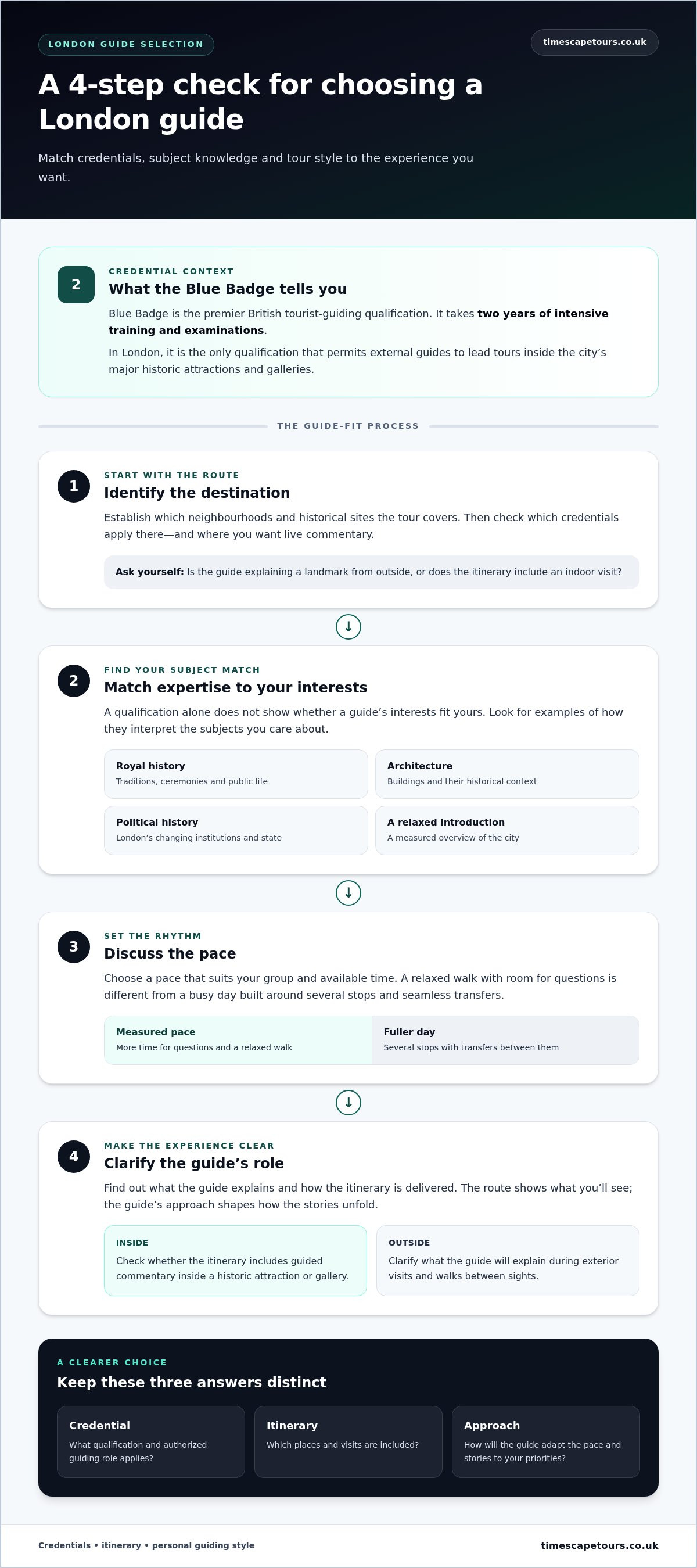
Blue Badge is the premier British tourist-guiding qualification, designed specifically for professional guides working in London, England. Earning this prestigious qualification takes two years of intensive training and rigorous examinations. When booking a London tour with a knowledgeable local guide, you can rely on the badge as the gold standard of UK-specific credentials, ensuring exceptional local authorization and deep historical expertise.
Within London, England, the Blue Badge is the only qualification that permits external guides to lead tours inside the city’s major historic attractions and galleries. That vital distinction matters whenever an itinerary includes expert guided commentary inside a landmark rather than just outside it. For your sightseeing experience, focusing on these official credentials guarantees seamless access and accurate, engaging storytelling throughout the capital.
A qualification alone, however, doesn’t show whether a guide’s specific interests match yours. One visitor may want an in-depth dive into royal history; another may prefer architecture, political history or a relaxed introduction to the city. Timescape Tours helps you look for a guide who can explain how they adapt the route and commentary to your unique priorities, rather than offering every visitor the exact same cookie-cutter experience.
Use these practical steps to assess a guide’s expertise:
Identify the destination. Establish which neighborhoods and historical sites the tour covers, then understand which credentials apply there.
Match expertise to interests. If you’re interested in architecture, look for examples of how the guide interprets buildings and their historical context.
Discuss the pace. A relaxed walk with plenty of time for questions differs from a busy day built around several stops and seamless transfers.
Clarify the guide’s role. Ask what the guide explains during the tour and whether the itinerary includes exclusive indoor visits or engaging exterior commentary.
These distinctions help set the right expectations for your journey. A credential, an itinerary and a personal way of guiding each answer different questions. The Blue Badge establishes a specific qualification and authorized guiding role in London, England. The itinerary shows what you’ll see, while the guide’s approach shapes how the fascinating stories unfold before you.
When booking a London tour with a knowledgeable local guide through Timescape Tours, always consider official credentials alongside destination-specific expertise. Think about where you want live commentary, which subjects hold your attention and whether you prefer a measured pace or a fuller day of discovery. A well-matched guide can make a museum visit or a walk through the bustling city feel completely coherent, personal and easy to follow.
London history and storytelling
London’s landmarks make more sense when a guide connects architecture with the people who shaped it. At Westminster, visitors can explore Parliament, royal ceremonies and the changing role of the British state. Around the City, historic streets sit beside modern buildings, offering a vivid way to discuss how commerce and daily life have evolved. Choose stories that interest you instead of trying to absorb every landmark at once.
Royal history also opens a window onto public life. The British Royal Family agreed to pay income tax to the British state, a detail that can prompt discussion about monarchy, responsibility and change. A guide can use a landmark such as Buckingham Palace as a starting point, then explain how royal traditions connect with London’s civic identity. These links give iconic sights more meaning than a photograph alone.
Explore London’s LGBTQ+ history and culture through places such as Soho, where venues and streets hold stories of community, visibility and social change. A thoughtful route can connect a neighbourhood’s past with the people who shaped its present. If this subject matters to you, share your interest when discussing the tour so the guide can give it meaningful space, rather than treating it as a passing detail.
Jewish history adds another strand to London’s story. Bevis Marks Synagogue and Spitalfields offer ways to explore Jewish religious life, migration and community. The East End’s streets help visitors understand how cultural traditions have taken root and changed across generations. These locations can also be part of a broader tour, linking local history with architecture, food and everyday urban life.
For first-time visitors, a highlights-focused route is a useful introduction because it brings several iconic sights into one coherent overview. A London Panoramic Tour suits visitors who want to take in the city’s major landmarks while hearing context along the way.
Meeting points depend on the route, so use the location named in your booking details as your starting point. London’s Underground and bus network can take you close to central landmarks. Travel to the specified station or street, then allow time to find the exact meeting spot.
Before booking, read the tour’s cancellation terms and check how its route accommodates access needs, including mobility requirements and step-free entry. Tipping is discretionary; consider the quality of the storytelling and service, and follow any payment guidance provided for the tour.
A good story-led route doesn’t need to cover every era or neighbourhood. Decide which themes matter most, such as royal history, LGBTQ+ culture or Jewish heritage, then choose a tour that can weave those interests into London’s wider story.
Tour durations and prices
London tours range from focused neighbourhood walks to full-day introductions, so match the duration to your priorities. A Camden and Primrose Hill walk lasts 2 hours, while a highlights walk with a riverboat ride takes 4 hours. These examples show how transport and distance shape the time needed, even before you add questions, photographs or breaks.
Shorter tours can suit visitors who want one clear theme. A family-friendly city tour lasts 2 hours, and a royal-history experience lasts 2.5 hours. A private British Museum visit also lasts 2.5 hours, giving visitors time to explore selected galleries with context. A tour centred on hidden corners and lesser-known stories can take 3 hours, leaving room for discoveries beyond the best-known sights.
For a broader overview, allow more time. A private Tower of London experience lasts 3 hours, while a walking tour covering London highlights lasts 4 hours. The longer format can connect several landmarks, but a longer itinerary isn’t automatically better. Consider how much walking suits your group, whether you want time inside attractions, and how many stops you’ll genuinely enjoy.
Prices depend on the tour and are provided after a quote request; key factors include duration, itinerary, transport and party size. A private tour may cost more overall than a small-group tour, but offers a different balance: your party can shape the pace, focus and questions. It may suit you if flexibility matters more than sharing the experience with other visitors. If you have a tight budget or prefer a fixed route, compare what each format includes before deciding.
Use these steps to compare options clearly:
Set a time limit. Choose a 2-hour walk for a compact visit or reserve a longer window for several landmarks.
Prioritise one theme. A British Museum visit, royal history or London’s hidden secrets can each anchor the itinerary.
Check what the duration covers. Distinguish walking time from travel between stops and time inside an attraction.
Compare the group format. Decide whether a private experience’s flexibility suits your party better than a small-group schedule.
For a first visit, a 4-hour highlights walking tour offers a substantial overview, while a 2-hour route can work around a fuller day. Visitors drawn to the British Museum may prefer a dedicated visit instead of rushing through it between distant landmarks. Choose one main experience, then leave breathing room for the city’s unexpected moments.
Guest reviews
Guest reviews are most useful when they describe the experience, not just award stars. Look for details about the guide’s explanations, walking pace and how well the route followed guests’ interests. A comment such as “the guide adapted the itinerary after we became interested in Victorian architecture” gives you more to assess than “excellent tour.”
Read several recent reviews rather than relying on one vivid account. Compare what different guests say about clarity, local knowledge and time for questions. If reviews repeatedly mention clear historical storytelling, that may suit visitors who want context at each stop. If your priority is a relaxed walk, focus on comments about pace and breaks.
Specific examples show how a tour works in practice. A review saying the guide explained a street’s history or answered questions about a landmark gives you a clearer picture of the commentary. For a family, details about keeping younger visitors engaged may matter more. If you’re interested in architecture, look for comments about building styles and design.
Use a simple comparison when reading reviews:
Match the reviewer’s priorities. A guest seeking a brisk overview may judge pace differently from someone wanting time for discussion.
Look for itinerary details. Named stops and descriptions of how they connect help you understand the route’s focus.
Notice how the guide responds. Comments about adapting explanations or answering questions can indicate a more personal experience.
Check practical observations. Walking distance, meeting arrangements and time spent at stops can help you picture the day.
Balance praise with useful specifics. A glowing review that only says “wonderful” reveals little about the guide’s approach, while a measured account can explain what worked and for whom. Read any response from the tour provider too: a thoughtful reply may clarify an itinerary detail or explain how a concern was addressed, without replacing the guest’s account.
Reviews reflect individual expectations, so compare them with your own plans. Someone who wanted a full day of famous sights may assess a neighbourhood walk differently from a visitor seeking hidden stories. Check whether the reviewed experience resembles the route and format you’re considering, especially when choosing between walking and driving.
Before booking, write down your two main priorities, such as historical depth and a flexible pace. Then scan reviews for evidence of both. This small step helps you judge whether the guide’s style and itinerary align with your visit, rather than choosing on a star rating alone.
London private tour guides
The best London tours are the ones that fit your interests, pace and preferred way to explore. For a broad introduction, choose a route linking landmarks such as Westminster and the Tower of London; for deeper context, focus on one subject, such as royal history or the city’s film locations.
Local-guided options include walking tours, food-focused outings, history tours and private tours. A walking route suits visitors who want to experience London’s streets up close, while a private tour brings your party and guide together without other guests joining the group.
A private format changes the conversation. You can ask questions as they arise, linger over an architectural detail or shift focus when a story captures your interest. A family curious about historic buildings, for example, may prefer a slower route with fewer stops. Visitors keen to see landmarks across different neighbourhoods may value a journey that links them.
Personalisation works best when you identify your priorities before setting the route. Consider which subjects matter to you, how much walking suits your party and whether you want to spend time inside attractions or see more of the city. Share those preferences with the guide so the itinerary has a clear focus, rather than an overloaded list of stops.
Guide profiles can also help you understand the perspective they bring. Andreea says she has lived in London by choice for over 10 years. That kind of local connection can add useful context, but look for evidence that a guide’s interests and approach match your own, too.
Use these questions to compare private London tours:
What should the tour centre on? Choose a theme such as history, food, architecture or film locations.
How will you travel? Decide whether walking or a drive-led experience better suits your group and route.
What would you like to change? Share your preferred pace, priority stops and subjects for discussion.
What does the review describe? Look for specific comments about the guide’s explanations, flexibility and handling of questions.
For a London tour with a knowledgeable local guide, being clear about your interests is more useful than trying to see everything. A private experience suits visitors who value personal conversation and an itinerary shaped around their party. A fixed route or shared group format may suit travellers who prefer a set schedule and the company of other guests.
Once you know what kind of experience you want, plan a tailored London journey around the landmarks and stories that matter to you.
Timescape Tours: Windsor Castle Tour
Timescape Tours offers a Windsor Castle Tour for visitors who want to explore royal heritage beyond central London. It’s a natural next step when you’re ready to pair city sightseeing with a destination rich in British history. For other interests, choose the Stonehenge and Bath Tour, The Cotswolds Tour or London Panoramic Tour.
Consider the experience you want before choosing: Windsor Castle centres on royal history, while the London Panoramic Tour keeps the focus on the capital. A journey beyond London suits visitors keen to discover historic landmarks and landscapes outside the city. Each option offers a different way to shape your time around the places and stories that interest you.
If a tailored London experience or a day beyond the capital fits your plans, contact Timescape Tours to discuss your interests, or visit timescapetours.co.uk.
Choose the London experience that feels like yours
Before you decide, picture the moment you want to remember: a story that changes how you see a familiar landmark, a conversation sparked by a hidden detail or a day shaped by your curiosity. That image can guide your choice of a London tour with a knowledgeable local guide, helping you focus on the experience rather than simply adding more stops.
If you’d like to extend your plans beyond the capital, Timescape Tours offers a Windsor Castle Tour, a Stonehenge and Bath Tour and The Cotswolds Tour. Each gives you a different way to explore England’s heritage and landscapes, while a London-focused experience keeps the city at the heart of your visit.
Let your interests shape the next step. Share the places and stories you’re drawn to, then explore an experience that suits your plans. Contact Timescape Tours about your London tour and begin shaping a memorable day in the city.
Frequently Asked Questions
How much do guided London tours cost per person?
There isn’t one per-person price for every guided London tour; cost depends on the format and what the experience includes. For a private driver-guided tour, the price depends on the itinerary, duration, vehicle and party size, and is provided after a quote request. To compare options, look at the total tour price, included transport and any separately paid admissions, then divide the total by the people travelling.
How long do London guided tours last, and what sights do they cover?
London guided tours range from focused neighbourhood visits to longer city itineraries. Tour durations and sights vary by route and theme. A highlights itinerary might connect central landmarks, while a museum-focused visit spends more time indoors. Before choosing, consider whether you want a broad city introduction or a slower exploration of one area, and compare the stated duration with the stops included.
How can I verify a London tour guide’s expertise and credentials?
Start by checking the guide’s name, stated qualification and experience against their profile or booking information. If a tour advertises a Blue Badge guide, confirm that the named guide holds that credential rather than assuming every guide on the tour does. Then read reviews for specific examples of historical explanations, clear answers and subject knowledge. A detailed account of how a guide handled questions is more informative than a general compliment.
What are the best neighborhoods and landmarks to explore with a local London guide?
The best choice depends on your interests: Covent Garden offers lively streets and performance history, while Bloomsbury suits visitors drawn to museums, literature and architecture. Shoreditch brings street art and changing urban culture into focus; Notting Hill offers a different neighbourhood character. For major landmarks, consider Westminster or the South Bank. Pair one area with a clear theme instead of trying to cross the whole city in a single outing.
Where do popular London tours meet, and how do you get there by public transport?
Meeting points depend on the route, so use the location named in your booking details. London’s Underground and bus network can take you close to central landmarks. Travel to the specified station or street and allow time to find the exact spot.


Comments