


Accessible London Tours: A Planning Guide

What if the most comfortable way to explore London isn’t to fit in more sights, but to plan each one around the journey between them? If you’re considering london tours for visitors with limited mobility, it’s natural to wonder how far you’ll need to walk, whether routes include steps or uneven surfaces, and where you can pause for a rest. A private vehicle may make some journeys easier to organise, but it doesn’t make every route, entrance or venue accessible.
The key is to plan transport, walking and stops together, shaping the day around the traveller’s priorities rather than a standard sightseeing schedule. This guide covers practical ways to plan a manageable visit, from checking route and venue access details to allowing time for breaks and choosing the places that matter most. You’ll also see how a bespoke itinerary and knowledgeable driver-guide can bring a more personal rhythm to sightseeing while keeping access considerations in view at every stage.
Table of Contents
London tours for visitors with limited mobility: start with the experience you want
Limited mobility means different things to different travellers. One person may use a wheelchair; another may manage short walks but need frequent rests, avoid steep slopes or conserve energy for a particular attraction. The best starting point for london tours for visitors with limited mobility isn’t a standard list of “accessible” sights. It’s an honest picture of what makes a day comfortable for your party.
A mobility-aware tour matches transport, routes, stops and pace to the visitor’s needs and priorities. It isn’t a blanket guarantee that every place or part of the journey will be accessible. A private vehicle can make travel between sights more individual, but doesn’t automatically resolve the walk from a drop-off point, access at an entrance or movement inside an attraction. Consider each part of the experience separately.
What does a mobility-aware London sightseeing plan involve?
Separate the journey between sights from getting around once you arrive. A car or taxi may reduce time spent on public transport, while the destination itself may still involve a walk, steps, uneven ground or a long route between exhibits. Streets and public spaces bring their own considerations: pavement surfaces, crossings, distance to facilities and places to pause can all affect how manageable a stop feels.
Before settling on an itinerary, discuss what works for the traveller. Consider their preferred walking distance, whether standing is tiring, how often they like to rest, and which surfaces or slopes are difficult. Access can differ between entrances, galleries and facilities within the same venue, so review the attraction’s current access information for the specific visit. A route that looks simple on a map may involve more movement than expected.
Which experiences matter most to your party?
Choose a few priorities before fitting sights together. Your party might be drawn to local history, notable landmarks, cultural attractions or waterfront views. Think about which experience matters most, then consider whether the surrounding area and route between stops suit the traveller’s preferences. Examples can help you identify the kind of outing you want, but a broad category doesn’t confirm access. Review current visitor information for each destination.
It can help for companions to agree on what matters most and what a comfortable day looks like. One traveller may want time to take in a landmark, while another may prefer fewer stops and longer pauses. Discussing those preferences early makes it easier to choose rewarding experiences rather than rushing through a list, and to save less essential options for another visit.
How to plan London sightseeing around mobility needs
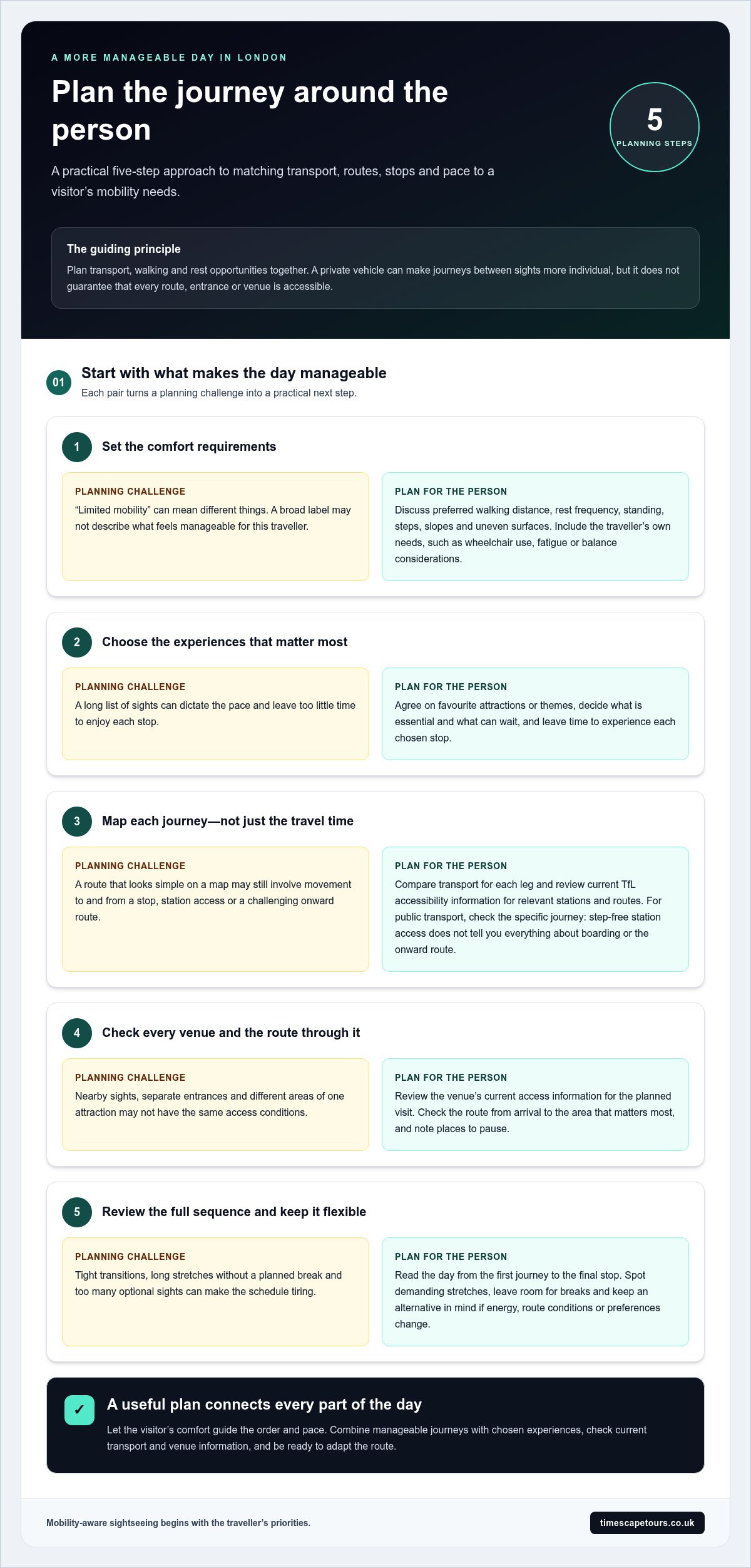
A thoughtful itinerary begins with the traveller, not a map full of landmarks. For london tours for visitors with limited mobility, the most useful plan puts comfort and preferred experiences first, alongside the practical details that shape each leg of the day. Work through these steps before settling on a route.
Describe what makes a day manageable. Consider how far the visitor prefers to walk, whether steps, slopes or uneven surfaces are difficult, and how often they like to rest. Wheelchair use, fatigue, balance needs and other mobility considerations aren’t interchangeable. Turn the person’s own experience into practical requirements rather than relying on a broad label or diagnosis.
Choose the experiences that matter most. Agree on preferred attractions or themes, then decide which are essential and which can wait for another visit. This stops an ambitious list from dictating the pace. Build the day around what the party will genuinely enjoy, with time to experience each chosen stop rather than simply arriving and moving on.
Map the journey between stops. Compare transport options for each leg and consider the route to and from the stop, not just journey time. Use current Transport for London (TfL) accessibility information to review relevant station access and route details. For public transport, check the specific journey: step-free access at a station doesn’t tell you everything about boarding or the onward route.
Review each venue separately. Consult the attraction’s own access information for the planned visit. Don’t assume nearby sights, separate entrances or different areas within one venue offer the same conditions. Note the details that matter to your party, including the route from arrival to the area they most want to see and places to pause.
Check the whole sequence and leave room to adjust. Read through the day from the first journey to the final stop. Look for tight transitions, long stretches without a planned break and optional sights that could make the schedule tiring. Keep an alternative in mind in case energy, route conditions or preferences change. A well-paced plan can evolve.
A useful itinerary connects transport, stops and access checks in one plan, with the visitor’s comfort guiding the order and pace. Choose a manageable combination of journeys and experiences instead of trying to cover every celebrated landmark. Revisit official transport information and each venue’s current guidance for the intended visit, since details can change.
If you’d prefer a more personal way to bring preferred sights and a considered pace together, explore Timescape Tours’ private, bespoke London tours. Itinerary planning is tailored around clients’ needs, interests and chosen sites, with a knowledgeable driver-guide accompanying the experience.
Private driving, public transport and walking: compare London tour options
Each way of moving around London creates a different balance of travel, walking and flexibility. For london tours for visitors with limited mobility, compare the demands of each leg with the traveller’s preferences instead of assuming one mode will suit the whole day. A journey that feels manageable between sights can still lead to a long walk after you arrive.
When can private driver-guided sightseeing be a better fit?
A private driver-guide can help make an outing more personal by shaping the order of stops around your interests and reducing the need to organise separate transfers between sights. Timescape Tours uses iconic Black Cabs for city cruising. This describes the vehicle option, not a particular access configuration. A vehicle choice alone doesn’t establish step-free access or wheelchair suitability. Plan how the traveller will enter and leave the vehicle, reach each attraction and move around once there.
When should public transport or walking shape the itinerary?
Public transport or walking may suit your party for particular journeys or neighbourhoods, but consider the demands route by route. TfL’s accessibility information can help you review transport options and relevant station facilities. Access arrangements differ across services and locations; step-free access at one point in a journey doesn’t describe every part of it.
For walking links, consider the visitor’s tolerance for distance and surfaces, along with seating and places to rest. Keep the plan adjustable if energy or preferences change during the day. The most suitable choice may combine modes, with a decision for each leg rather than one method for the whole itinerary.
How to make London sightseeing more comfortable and flexible
A comfortable day is shaped as much by its rhythm as by its destinations. For london tours for visitors with limited mobility, fewer thoughtfully chosen stops can offer a richer experience than a packed schedule, especially when the plan leaves room for rest and changes of pace. Use this checklist to make the itinerary feel considered rather than restrictive:
Set a gentle pace. Choose a realistic number of stops and leave time to enjoy each one without rushing to the next.
Plan pauses that suit the visitor. Consider whether a quiet break, a place to sit or extra time between activities would make the day more comfortable.
Keep optional stops optional. Mark possibilities as flexible so the party can decide how much to include as the day unfolds.
Choose meaningful sights. Prioritise places that genuinely interest your party instead of treating a landmark checklist as a target.
Review the practical details. Check current venue access information and transport routes before setting the day’s sequence, then revisit the plan if service information changes.
Build in breathing space without losing the day’s character
Nearby attractions may look easy to combine, but distance alone doesn’t show whether the link between them will feel manageable. Consider the actual route, surfaces and visitor’s comfort before grouping stops. Build breaks around personal preferences and resist filling every gap in the schedule. A flexible pause can preserve the pleasure of a day out, while an optional stop gives the party room to slow down or change direction.
Choose sights by interest and access information
Once the day’s priorities are clear, review each attraction individually. Use the venue’s current official information to check the intended entrance, routes within the site and visitor facilities. Conditions can vary across different parts of a destination and may change over time. If your party is considering an excursion, plan it separately rather than squeezing it into an already full city itinerary. A private Windsor Castle tour can be considered as a distinct outing, with travel and venue access planned around the visitor’s needs.
If you’re weighing up a day beyond the capital, this guide to the best day trips from London offers ideas to consider separately. Choose the outing that suits your party’s interests and leaves enough breathing room to enjoy the experience.
Timescape Tours creates private, bespoke London itineraries around clients’ needs, interests and chosen sites. Explore a bespoke London sightseeing experience with a personal driver-guide and a thoughtfully tailored route.
Plan a bespoke London tour with Timescape Tours
A private driver-guided tour can bring London’s stories and landmarks into a more personal journey, with a knowledgeable guide accompanying you as you explore. Timescape Tours builds bespoke itineraries around clients’ needs, interests and chosen sites, so you can shape a day around what your party most wants to see.
What a personal driver-guide adds to a London visit
The experience combines private transport with in-person historical guidance. As you travel, your driver-guide can add context to the city’s streets and sights, making the route part of the experience rather than simply a transfer between destinations. Local knowledge can also inform the choices you make together, from which interests to prioritise to how the day’s stops are arranged.
Timescape Tours’ proprietor and Chief Guide, Mark Cairns, leads a team of fully qualified, properly licensed and insured driver-guides. Vehicle options include iconic Black Cabs for city cruising and executive-class saloon cars for day trips. These details describe the service and vehicle choices, not a promise about wheelchair suitability or step-free access. A private vehicle doesn’t establish access at pick-up points, attraction entrances or within venues, so include those details in your planning.
Shape the itinerary around your priorities
Begin with the sights and interests that matter most to your party, then build an itinerary around those choices. You might centre the day on London landmarks, a historical theme or a small number of preferred stops, with the pace and sequence tailored to your plans. Sharing practical mobility priorities during planning helps keep the itinerary personal rather than built around a generic sightseeing checklist.
Bespoke planning can tailor the route and chosen stops, but it doesn’t guarantee access in a vehicle or at a venue. Review current access information for each attraction and consider the movement involved beyond the journey itself. This distinction matters for london tours for visitors with limited mobility: a carefully arranged itinerary can make the experience more individual, while each part of the visit still has its own access considerations.
If a personal, guided approach fits the way you’d like to experience the capital, explore a bespoke London tour with Timescape Tours. Share the interests and chosen sights that matter to you, and let them shape a considered journey through London.
Begin shaping a London day around what matters to you
Turn mobility priorities into a travel plan that feels personal: decide which experiences you most want to remember, what pace feels comfortable and where flexibility would make the day easier. This gives you a thoughtful starting point for london tours for visitors with limited mobility, without compromising on the history, character or sights that brought you to the capital.
Timescape Tours offers private, driver-guided London tours with bespoke itinerary planning shaped around clients’ needs, interests and chosen sites. Fully qualified, properly licensed and insured driver-guides bring knowledgeable, in-person guidance to the journey. The itinerary can reflect your priorities, while each venue and vehicle still needs to be considered on its own access details.
Explore a bespoke private London tour with Timescape Tours and start imagining a London experience shaped around your party. With a considered plan and the right sights at its heart, the city can unfold at a pace that feels more your own.
Frequently Asked Questions
Is London suitable for visitors with limited mobility?
Yes, London can be explored in ways that suit different mobility needs, though the practical experience varies by journey and venue. For example, a visitor who finds long walks tiring might plan around one priority attraction and a separate sightseeing journey rather than linking several sites on foot. Check official access information for the specific route and venue, and shape the day around what the traveller feels comfortable doing.
Can I take a private London tour if I have limited mobility?
Yes, a private driver-guided tour can offer a personal way to organise London sightseeing around your interests and preferred stops. Consider the entire visit, including getting in and out of the vehicle, reaching the attraction entrance and moving through the areas you hope to see. Private transport doesn’t establish that a vehicle or venue is suitable for a particular mobility need, so consider each part separately.
How do I plan a London itinerary for someone who cannot walk far?
Start by asking the visitor which experience matters most and what amount of walking feels manageable. For london tours for visitors with limited mobility, a practical approach might be to choose one main sight, then consider whether another stop would add enjoyment without making the day feel demanding. Review current venue and transport information, including the route from the arrival point to the entrance, and leave room to pause or change the plan.
Are London attractions accessible for wheelchair users?
Access varies between London attractions and sometimes between entrances or areas within the same venue, so there isn’t one answer for every site. Consult the attraction’s official access guide for details relevant to your visit, such as routes through the building and visitor facilities. Historic settings may have physical constraints in some areas, so focus on the specific spaces your party hopes to experience rather than relying on a general description of the venue.
Is the London Underground suitable for visitors with limited mobility?
It depends on the visitor’s needs and the particular stations and connections on the journey. Use Transport for London’s current journey-planning and accessibility information to review the route, station facilities and any changes that could affect the trip. A station’s access arrangements don’t automatically describe every part of a journey, so consider the interchange, boarding and onward walk to the intended sight as part of the same outing.
Can a private driver-guided tour guarantee wheelchair access at London sights?
No. A private tour can shape the sightseeing itinerary, but it can’t guarantee access at every venue, pavement or entrance, and the vehicle alone doesn’t establish wheelchair suitability. Consider each part of the visit: boarding and leaving the vehicle, reaching the entrance, and moving between the areas of interest. Use each attraction’s current official access information to decide whether the planned experience fits the visitor’s requirements.
What should I check before booking a London tour with limited mobility?
First, describe the traveller’s practical priorities, such as preferred walking distance, comfort with steps and the pace they enjoy. Then review current information for the journey and each planned venue, paying attention to the route from arrival to the areas they want to visit. Keep the itinerary focused on meaningful experiences, and consider which stops could be shortened or omitted if the visitor would rather take more time.


Comments