


Visiting Chartwell, Kent: The Discerning Traveller’s Guide for 2026
- Mark Cairns
- Mar 31
- 12 min read

What if the most defining moments of 20th-century history weren't forged in a Whitehall bunker, but over a bricklayer’s trowel beside a quiet pond in the Kentish countryside? You likely agree that the logistical puzzle of coordinating multiple transport connections from London to chartwell kent can often overshadow the beauty of the destination itself. It’s a common frustration to arrive at such a storied home only to feel hurried by the rigid pace of a standard group itinerary. You deserve a journey that matches the stature of the man who lived there.
Our expert guide ensures your 2026 visit is a seamless, door-to-door experience that prioritises historical depth and personal comfort. We'll show you how to plan a bespoke excursion that avoids the typical 11:00 AM tourist rush and brings the house to life through intimate details often missed by the casual observer. We'll provide a curated look at how to string together the perfect itinerary, ensuring you experience the house and gardens with the unhurried grace they require. From the specific light in his garden studio to the quiet corners of the grounds, this is your map to an intellectually stimulating and perfectly paced adventure.
Key Takeaways
Discover why this intimate family retreat in the heart of the Weald provided the "splendour" Sir Winston Churchill required for his most productive years.
Learn how to navigate the logistical complexities of the English countryside with a private driver-guide for a seamless journey to chartwell kent.
Uncover the treasures within the House and Studio, including the largest collection of Churchill’s own paintings, preserved exactly as he left them.
Master the art of "stringing together" a curated day trip by pairing your visit with other nearby historical landmarks like the iconic Hever Castle.
Find out how a bespoke, executive-class tour provides the expert historical context and flexibility that discerning travellers demand.
Table of Contents Why Chartwell, Kent is the Ultimate Pilgrimage for Churchill Admirers What to See at Chartwell: The House, the Studio, and the Gardens London to Chartwell: Comparing Transport and Logistics Stringing Together a Perfect Day in the Garden of England Booking Your Bespoke Chartwell Experience with Timescape Tours
Why Chartwell, Kent is the Ultimate Pilgrimage for Churchill Admirers
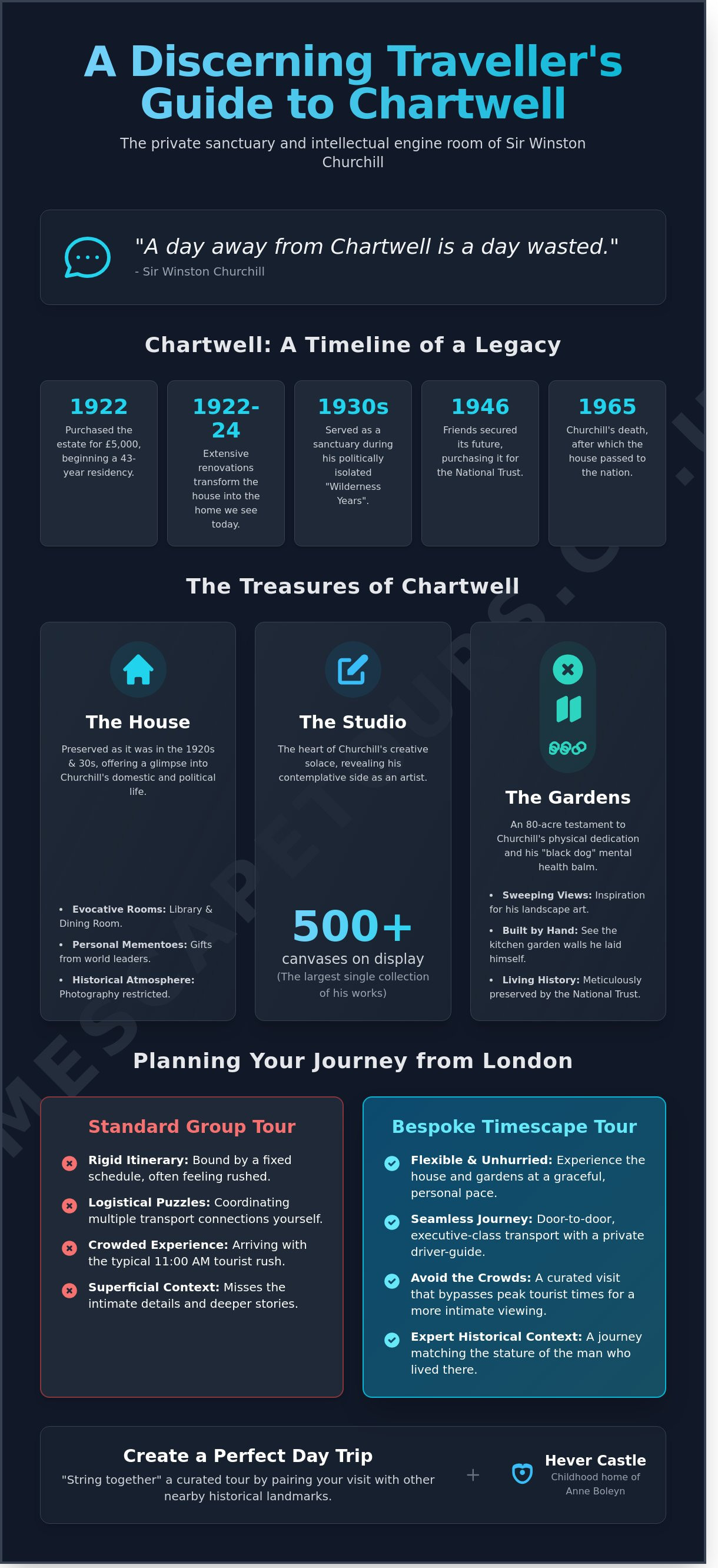
Sir Winston Churchill's connection to chartwell kent began in September 1922 when he purchased the estate for £5,000. For the next 43 years, until his death in January 1965, this house served as his primary residence and intellectual engine room. It's here, nestled within the rolling hills of the Weald of Kent, that the statesman found the "splendour" and solitude necessary to navigate the most turbulent decades of the 20th century. For the discerning traveller in 2026, visiting Chartwell is less about viewing a museum and more about stepping into the private world of a man who was as much a bricklayer and landscape artist as he was a Prime Minister.
The Sanctuary of a Statesman
Churchill famously remarked that "a day away from Chartwell is a day wasted." This sentiment wasn't mere hyperbole; the estate acted as a vital psychological anchor during his "Wilderness Years" in the 1930s. The sweeping views across the Kentish Weald provided a necessary balm for his mental health, which he often described as his "black dog." In 2026, the National Trust continues its meticulous preservation of the grounds, ensuring that the 80 acres of gardens and woodland remain exactly as Churchill envisioned them. Visitors can witness the physical results of his manual labour, including the kitchen garden walls he personally built using techniques he learned as a member of the Amalgamated Union of Building Trade Workers.
A Brief History of the Estate
The property's origins date back to at least the 14th century, but the house we see today is largely the result of extensive renovations Churchill oversaw between 1922 and 1924. While he focused on the structural "splendour," Clementine Churchill was instrumental in managing the often-strained domestic finances and shaping the home's interior life. Chartwell's history took a pivotal turn in 1946 when a group of Churchill’s wealthy friends, led by Lord Camrose, purchased the house to ensure he could live there for the remainder of his life before it passed to the National Trust. This bespoke arrangement allowed the family to remain in their beloved home while securing its future as a national monument. Today, chartwell kent remains a site of profound historical resonance, offering a rare look at the man behind the myth.
What to See at Chartwell: The House, the Studio, and the Gardens
Stepping onto the grounds of this estate feels less like visiting a museum and more like entering the private sanctuary of the man who shaped the 20th century. This beloved family home in chartwell kent remains largely as it was during the interwar years, offering an intimate glimpse into the domestic life of Sir Winston Churchill. He purchased the property in 1922, and it served as his primary residence for over forty years, providing a backdrop for both his darkest "wilderness" years and his greatest triumphs.
Inside the Churchill Home
The rooms within the main house are preserved with meticulous care to reflect the atmosphere of the 1920s and 1930s. You'll find the Library and the Dining Room particularly evocative; these spaces served as the nerve centres for high-stakes political debate while Churchill was out of office. On the shelves and tables, personal mementoes sit alongside prestigious gifts from world leaders, including a gold-and-enamel box from the People of Stalingrad.
To preserve this fragile historical atmosphere, the National Trust restricts photography in several rooms. When Visiting Chartwell, it's best to allow the quiet dignity of the house to speak for itself without the distraction of a lens. If you'd like to explore these halls with a guide who can reveal the stories behind every silver inkwell, we can easily curate a bespoke day trip tailored to your historical interests.
The Artist in the Garden
Churchill found his most profound solace in creative pursuits, and nowhere is this more evident than in the Studio. This detached building houses the largest collection of his work, featuring over 500 canvases that reveal a softer, more contemplative side of his personality. The Studio remains filled with the scent of oil paints and the quiet energy of a man who used the brush to escape the pressures of Westminster.
Outside, the gardens showcase his physical dedication to the land. You can still see the extensive brick wall he built with his own hands between 1925 and 1932, a testament to his need for tactile engagement with his estate. The panoramic views over the Weald of Kent inspired many of his landscape paintings, though he also took delight in smaller, whimsical details.
The Marycot: A charming brick playhouse built specifically for his youngest daughter, Mary.
The Kitchen Garden: A productive space that provided fresh produce for his legendary dinner parties.
The Golden Orfe: Near the lake, you might spot the descendants of the vibrant fish Churchill fed daily from his chair, a ritual he continued well into his final years.
The grounds of chartwell kent offer more than just a walk; they provide a narrative of a man who was as comfortable with a trowel or a paintbrush as he was with a pen or a cigar.
London to Chartwell: Comparing Transport and Logistics
Reaching chartwell kent requires more than just a train ticket if you value your time and comfort. While the map shows a mere 25 miles between Central London and the Churchill estate, the transition from urban sprawl to the rolling North Downs presents a logistical puzzle. For the discerning traveller, the goal isn't just arrival; it's the preservation of the day's narrative flow without the friction of rural infrastructure.
The Public Transport Reality
Trains depart London Victoria for Sevenoaks or Oxted every 30 minutes, with the fastest services reaching their destination in about 32 minutes. However, the "final mile" remains a significant hurdle. Chartwell sits nearly 6 miles from the nearest station, tucked away on a winding country lane that local buses serve only sporadically. In 2026, relying on these connections often turns a straightforward 75-minute journey into a 3-hour ordeal of missed links and standing on rain-swept platforms. Taxis at rural stations are notoriously unreliable, often requiring a 20-minute wait during peak visiting hours.
The Luxury of a Private Driver-Guide
Choosing an executive vehicle transforms the transit into a curated prelude. Your day begins with a door-to-door pickup from your London hotel at 9:00 AM, avoiding the rush of the morning commute. We'll navigate the "Hidden Kent" route, trading the monotonous M25 motorway for the picturesque lanes of the Weald. This approach allows us to adjust our pace based on the morning’s mist or a sudden burst of English sunshine, ensuring you arrive at the gates exactly when the crowds are thinnest.
The true value of a bespoke driver-guide lies in the intellectual bridge we build during the drive. As we leave the capital, we'll trace the history of the Blitz sites in Westminster and connect them to the sanctuary Churchill found in the countryside. This house was his fortress of thought, a theme explored deeply by the International Churchill Society in their records of Churchill's life at Chartwell, providing a context that a solitary train ride simply cannot offer. It's a seamless experience where the storytelling begins the moment the car door closes. You'll find that visiting chartwell kent with a dedicated guide turns a simple site visit into a deep immersion into 20th-century history.
Direct Access: Door-to-door service saves approximately 2 hours of transit time per day.
Bespoke Flexibility: We can easily "string together" a visit to nearby Hever Castle or the village of Westerham.
Comfort: Travel in an executive class vehicle with climate control and refreshments.
Stringing Together a Perfect Day in the Garden of England
While Chartwell is undoubtedly the crown jewel of the area, the true magic of a private tour lies in how we weave several stories into a single, seamless narrative. A visit to chartwell kent offers the perfect anchor for a day spent exploring the High Weald, an Area of Outstanding Natural Beauty that has remained remarkably unchanged for decades. By carefully planning your route, you can experience the transition from 20th-century statesmanship to medieval romance within a single afternoon.
Combining Chartwell with Hever Castle
Just a short 20-minute drive through winding country lanes sits Hever Castle, the childhood home of Anne Boleyn. The contrast is striking; you move from the mid-century cigars and polkadot bow ties of Churchill to the 13th-century double-moat and Tudor intrigue of the 1500s. We often recommend this pairing because it showcases the breadth of English history in one afternoon. Much like our Stonehenge and Bath tour from London, stringing these sites together allows for a richer, more nuanced understanding of how different eras shaped our national identity.
Exploring Westerham and the Weald
Westerham serves as our gateway to the Weald. On the village green, you'll find the bronze statue of Churchill looking out over the town, alongside a monument to General James Wolfe, the hero of the 1759 Battle of Quebec who was born in the village. The drive between these stops takes us past traditional Kentish hop gardens and apple orchards that still produce the region's famous cider and ale. On our return to the capital, we can customise the route to include a panoramic entry, perhaps crossing the Thames at Chelsea to see the city lights begin to flicker against the twilight.
For your midday meal, you have two distinct paths to choose from:
The Chartwell Café: Ideal for those who want to maximise their time amongst the gardens, offering fresh, seasonal produce often sourced from the estate itself.
Traditional Kentish Pubs: The Grasshopper on the Green in Westerham provides a quintessential experience with its low-beamed ceilings and local bitters.
The Royal Oak: A 17th-century coaching inn nearby that offers a more formal, refined lunch for the discerning palate.
Whether you prefer a quick artisanal sandwich or a leisurely three-course meal, the local area provides a sense of authenticity that large tour buses simply can't reach. It's these small, bespoke details that transform a simple excursion into a lifelong memory of the English countryside.
Ready to plan your own bespoke journey? Explore our private tour options to begin your adventure.
Booking Your Bespoke Chartwell Experience with Timescape Tours
Exploring the legacy of Sir Winston Churchill shouldn't feel like a rushed excursion; it's a journey into the heart of British history. Our private tours offer an intimacy that large coach groups cannot replicate. You'll have the undivided attention of a licensed driver-guide who doesn't just recite dates. They understand the nuances of Churchill’s life at chartwell kent, from his darkest hours to his most inspired moments of painting and bricklaying. We provide a sanctuary of comfort and deep historical insight, ensuring your day is as intellectually stimulating as it is relaxing.
The Timescape Difference
We reject the "one size fits all" approach of standard travel companies. Our bespoke philosophy means there are no fixed schedules, only personal journeys tailored to your pace. You'll travel in the quiet luxury of an executive vehicle, a significant upgrade from the cramped conditions of a standard taxi or public transport. If you're beginning to map out your journey, our Pillar Article on Chartwell offers a wealth of inspiration for planning your ideal itinerary through the Garden of England.
Plan Your 2026 Visit
Timing your visit to chartwell kent can transform your experience. We recommend May 2026 for those who wish to see the gardens in their peak spring vibrancy, or October 2026 to witness the dramatic autumnal foliage of the Weald. Logistics are our speciality. We handle the complexities of National Trust entry and secure those elusive timed tickets for the house, which often sell out months in advance. We've managed hundreds of successful entries, ensuring our guests walk straight into the history they've come to see.
I'm here to help you string together the perfect day, perhaps combining the Churchill legacy with a visit to a nearby medieval castle or a world-class Kentish vineyard. It's about creating a narrative that resonates with you personally. Reach out to me, Mark Cairns, to secure your preferred 2026 date and let's begin crafting an English adventure that you'll remember for a lifetime.
Secure Your Place in Churchill’s Private Sanctuary
A pilgrimage to chartwell kent offers an unparalleled connection to the man who led Britain through its darkest hours. You've seen how the 80-acre estate, featuring the studio where Churchill completed over 500 paintings and the house he lovingly renovated in 1922, serves as a living museum of 20th-century history. By stringing together your visit with a stop at the 13th-century Hever Castle or the picturesque village of Westerham, you'll create a day that's uniquely yours. Experience this journey without the constraints of a rigid timetable or the bustle of a crowded coach.
Our expert, licensed driver-guides provide a sophisticated narrative as they navigate the Kentish lanes in executive class vehicles designed for your ultimate comfort. We take pride in creating bespoke itineraries tailored entirely to your interests, ensuring your 2026 visit is both relaxed and deeply intellectual. Book your bespoke private tour to Chartwell from London today and let's begin planning your perfect day in the Garden of England. We can't wait to welcome you on a truly curated adventure.
Frequently Asked Questions
How much time do you need at Chartwell Kent?
You should allow a minimum of four hours to properly explore the house, gardens, and studio. This timeframe gives you 60 minutes for a timed entry tour of the rooms and another 90 minutes to wander the 80 acre estate. When we arrange a visit to chartwell kent, we often suggest a full morning to ensure you don't rush through the library where Churchill's Nobel Prize for Literature is displayed.
Is Chartwell House open to the public all year round?
Chartwell House follows a seasonal schedule, typically closing its doors for essential conservation between early November and late February. While the house remains shut during these four months, the gardens, shop, and cafe usually remain open to visitors from 10:00 to 16:00. In 2026, you should check the National Trust calendar for specific winter weekends when selected ground floor rooms might be accessible.
Can you visit Chartwell without a National Trust membership?
You can certainly visit without a membership by purchasing a standard admission ticket at the visitor centre. For the 2026 season, an adult ticket for the whole property is expected to cost approximately £22.00. If you only wish to see the gardens and studio, the price is reduced to around £15.00. Pre-booking a timed entry slot for the house is essential during peak summer months to guarantee your entry.
What is the best way to get to Chartwell from London?
The most seamless way to reach the estate is via a private driver-guide in an executive class vehicle, which takes about 90 minutes from central London. If you prefer the train, take a 35 minute service from London Bridge to Sevenoaks station. From there, a 6 mile taxi journey will deliver you to the gates of chartwell kent. This avoids the complexities of local bus schedules which are often infrequent.
Are there places to eat at Chartwell?
Dining options are available at the Landemare Cafe, named in honour of Georgina Landemare, the Churchill family's cook for 15 years. The cafe serves seasonal lunches and traditional afternoon tea using produce grown in the onsite kitchen garden. For a more bespoke experience, we can suggest several historic pubs in the nearby village of Westerham, located just 2 miles down the road.
Is Chartwell accessible for those with mobility issues?
Accessibility is provided on the ground floor of the house, though the upper floors are only reachable via a 19th century staircase. The National Trust provides a volunteer-led buggy service to help visitors navigate the steep 80 acre hillside. Two all-terrain tramper mobility scooters are available for hire; however, you must reserve these at least 48 hours in advance to ensure availability.
Can you combine a visit to Chartwell with Hever Castle in one day?
Combining these two iconic sites is a popular choice as they sit just 6 miles apart, roughly a 15 minute drive. We frequently string these locations together into a single, rich day of English history. You might spend your morning exploring Churchill's private world before heading to Hever Castle for a 14:00 lunch and an afternoon immersed in the childhood home of Anne Boleyn.
Why was Chartwell so important to Winston Churchill?
Churchill purchased the estate in September 1922 and it remained his primary residence for over 40 years. It was here that he wrote many of his most famous speeches and painted over 500 canvases in his garden studio. The house served as his political headquarters during his wilderness years in the 1930s, making it the true heart of his private and professional life until his death in 1965.


Comments